How to optimize your preference mapping and segmentation ? RECO#2
Operational and actionable segmentation of preferences
Preference mapping or “prefmap” aims to establish links between the objective sensory characteristics of products (judged by a panel of experts) and consumer preferences. It serves as a guide for R&D to optimize formulations, by modeling the ideal sensory profile that maximizes consumer preferences.
However, preference is rarely consensual. Within the market, different segments may have different expectations.
Traditional segmentation (or clustering) methods can sometimes produce groups with heterogeneous preferences, making analysis complex and recommendations difficult.
Our approach: segmentation based on ‘true’ preference, not rejection
Repères’ segmentation technique is distinguished by an approach based on explicit preference for one type of product (and only one).
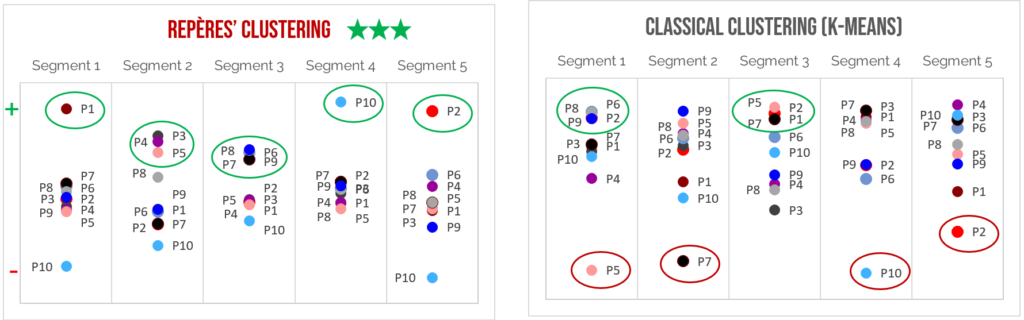
Unlike conventional methods, such as “K-Means”, for example, we focus on true preferences rather than rejection, enabling us to identify consumer segments with a truly marked and homogeneous preference.
The example below, comparing the 2 clustering techniques on the same set of 10 products, clearly illustrates that Repères’ segmentation identifies groups of consumers with a clear preference for a type of product. In contrast, the segments found by classic clustering are more affected by rejection than by preferred products, resulting in less homogeneous and less usable groups.
Clearer and more operational segments
Repères’ segmentation enables us to obtain groups of consumers with distinct preferences, for one (and only one) type of product. This makes it easier to identify the specific sensory expectations of each segment, and to model ideal profiles.
In the illustration below, our preference mapping (projection of consumer preferences onto sensory space) clearly shows a well-defined zone of maximum preference (in red) for each of the 4 consumer segments, covering the full sensory variety.
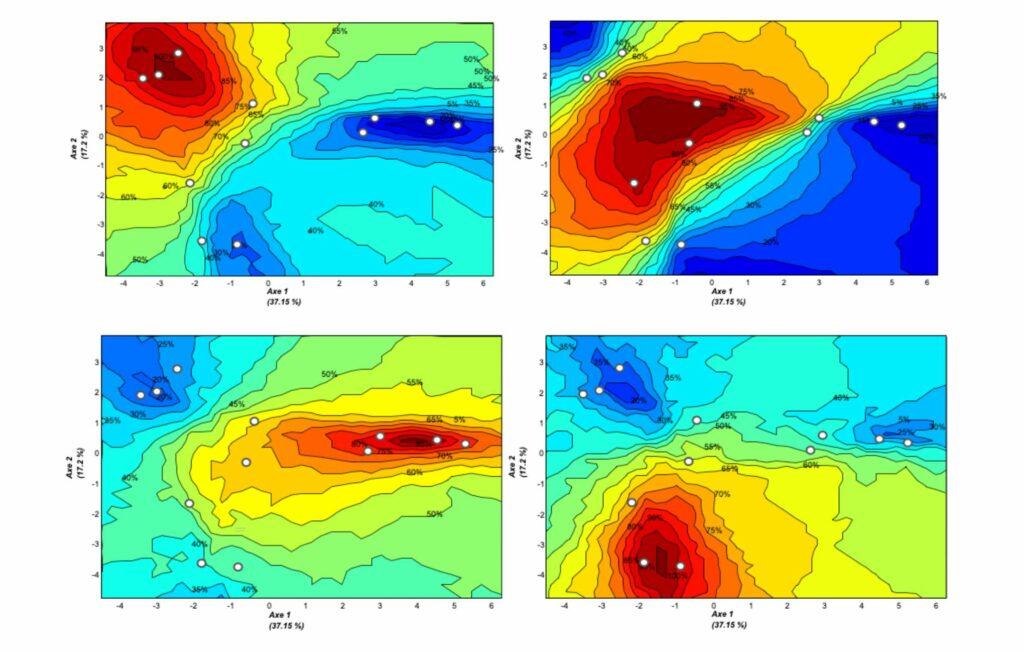
Whereas conventional methods can produce segments with dispersed preferences (with several preference zones) and therefore less actionable.
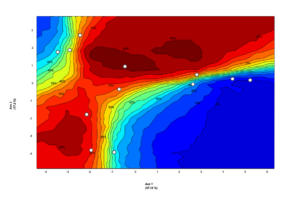
The Repères method guarantees precise segmentation of preferences, providing R&D teams with concrete, actionable levers for developing a product offer tailored to the different market expectations.
We also propose to go a step further by integrating spontaneous consumer reactions into preference mapping studies, for a better understanding of the perception and to make the link between consumer preferences and sensory descriptors.
Also, see our other recommendations for optimized prefmap studies:
RECO#1: CAPITALIZE ON CONSUMER SPONTANEOUS FEELINGS TO GO BEYOND SIMPLE LIKING
RECO#3 : BETTER UNDERSTAND AND TARGET YOUR PREFERENCE SEGMENTS
RECO#4: INTEGRATING LIKING INTO THE CONSTRUCTION OF THE SENSORY MAP