PREFMAP: From Preference Segments to Digital Personas
Your Prefmap tells you which recipe to develop for each consumer segment. It doesn't tell you how to convince them to buy it.
Yet at first purchase, nobody has tasted the product yet: packaging, claims and communication drive the decision in store. You still need to know who your segments are, beyond their tastes, to know how to target them and speak to them.
By enriching preference segmentation with psychometric measures and AI-moderated qualitative interviews, then bringing each segment to life as a conversational Digital Persona, Repères connects the ideal product to the message that will get it chosen in store.
Prefmap reveals preference segments and their ideal recipes
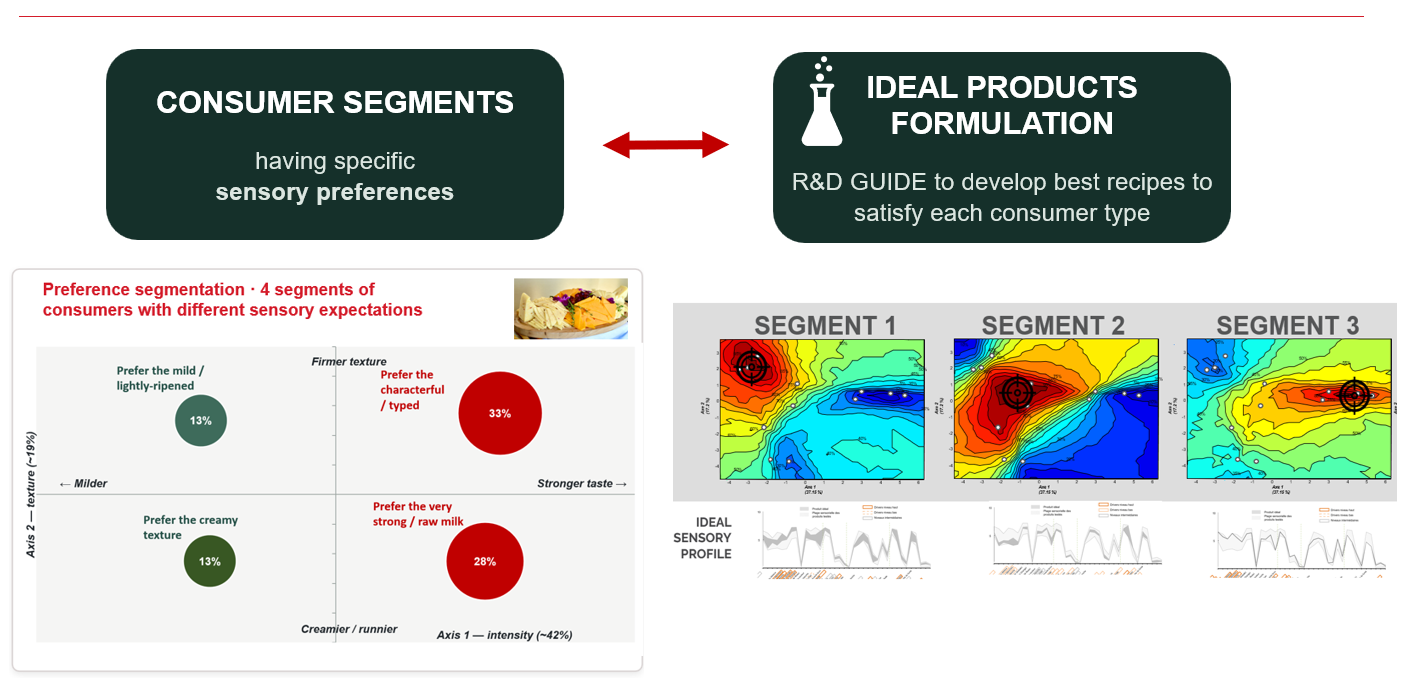
Preference mapping (Prefmap) groups consumers according to their sensory preferences, based on how much they like products tasted blind. The result is a set of stable preference segments that R&D can use directly: for each one, an ideal sensory profile guides the development of the best recipe.
But an ideal product may never reach its target
In store, sensory attributes carry little weight in the first purchase: the consumer hasn't tasted the product yet. It is advertising, packaging and the product promise that lead them to choose something new. To win over each segment, you therefore need to understand what characterises it beyond taste, in order to build a targeted marketing mix.
Understand who your segments really are
Socio-demographic and behavioural data rarely set preference segments apart. What separates them are deep-seated psychological and cultural drivers: their relationship with themselves, with their body and health, with sensations, with others, with consumption and with the product...
These drivers shape contrasting mindsets. For example, on one side you may find a segment rooted in pleasure, calling for an emotional, soft and rounded tone focused on the product's sensory experience. On the other, a profile driven by control and rigour, calling for a direct and authentic tone, backed by quality labels, brand credibility and nutritional benefits.
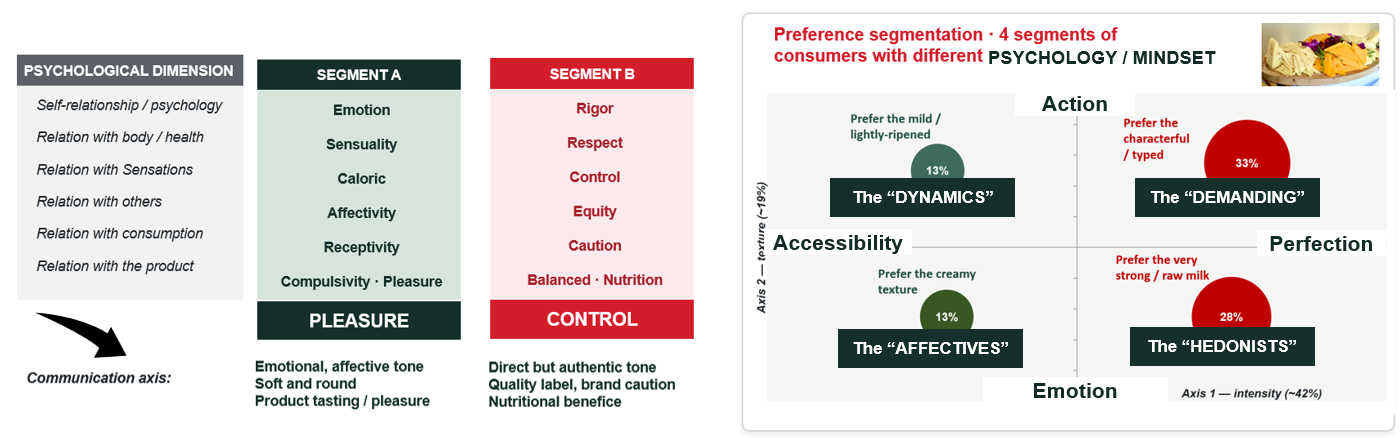
Our sensory preference segments are thus complemented by their psychological profiles.
To achieve this, each segment needs to be explored in depth.
The method: enriching your segments in two steps
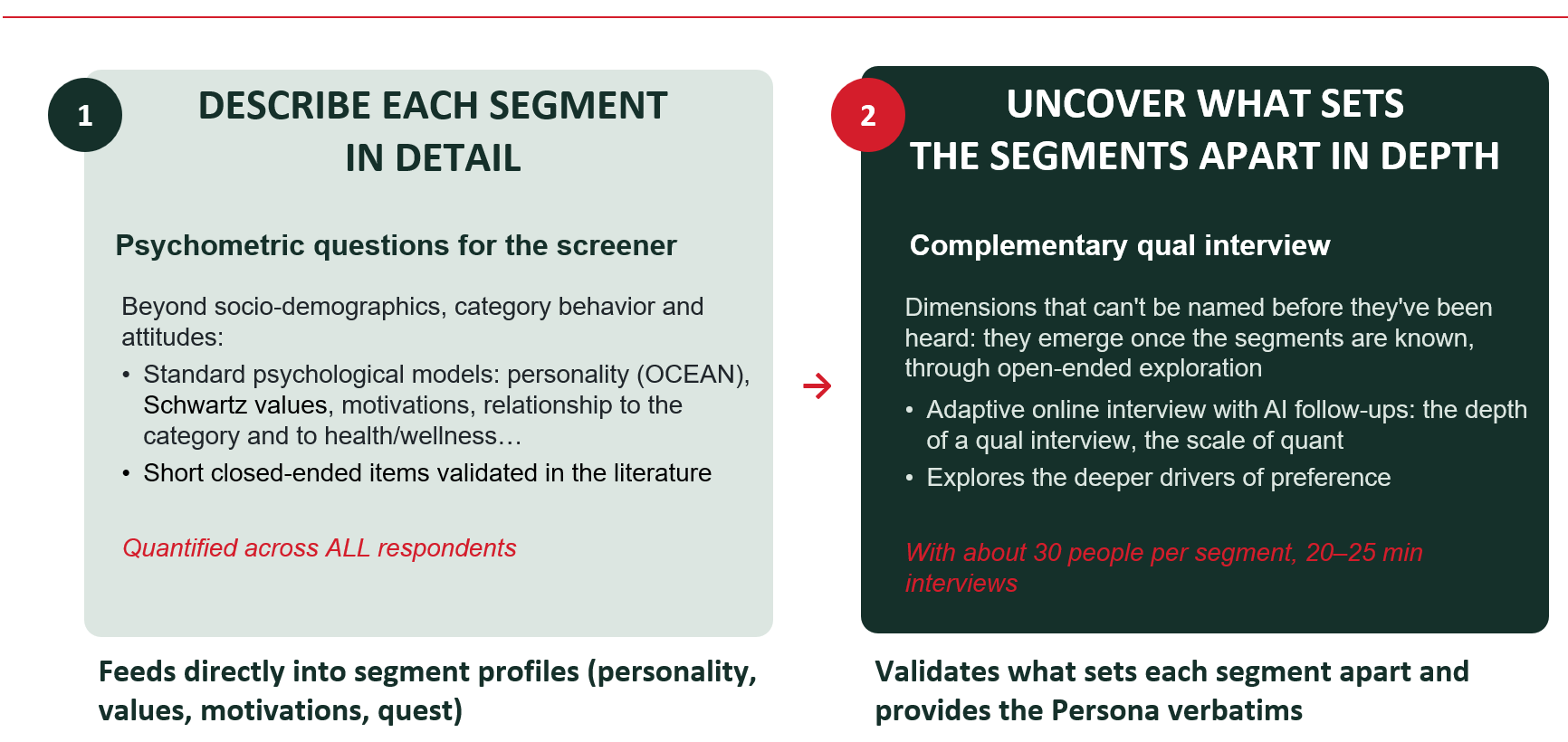
Step 1: describe each segment in detail
Beyond socio-demographic, behavioural and category attitude questions, we add standard psychological models to the questionnaire: personality (OCEAN), Schwartz values, motivations, and relationship with food, health and the category. Items are short, closed and validated in the literature.
Asked to all respondents, at recruitment or during tasting sessions, they directly feed the quantified profile of each segment and its description.
Step 2: discover what sets segments apart in depth
Some dimensions cannot be named before they have been heard. They emerge once the segments are known, through open exploration. Hence a qualitative interview conducted with selected Prefmap respondents.
This qualitative interview can be carried out online, through an adaptive AI-moderated questionnaire, delivering the depth of a qualitative interview at quantitative scale.
Lasting 20 to 25 minutes, it covers a range of themes such as the consumption experience with the category, the relationship with food and purchase criteria, self-portrait and lifestyle... Each theme opens with an open-ended question; the AI reads the answer, then follows up to dig deeper and explore. On key themes, it summarises what has been said and asks the respondent to confirm, correct or add to it.
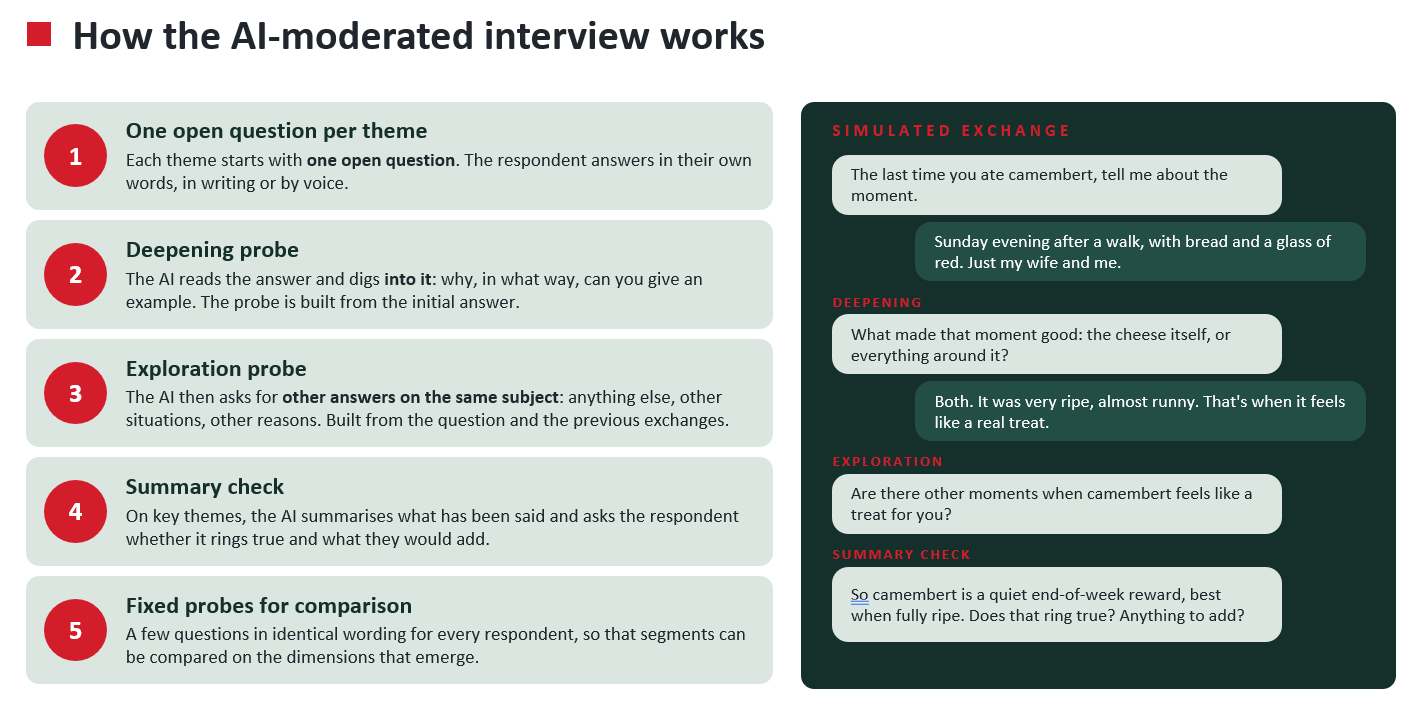
Around 30 interviews per segment, targeting the Prefmap respondents most representative of their segment (those with the most marked preferences):
- Enough for robust Personas: within a homogeneous segment, qualitative saturation is generally reached between 12 and 20 interviews. Thirty leaves room for less talkative respondents and for the two-phase design.
- Enough to confirm the marked contrasts between segments on comparison questions.
- Far more than a traditional qual study (6 to 8 face-to-face interviews per segment), at a fraction of the cost thanks to AI.
Bring your segments to life as Digital Personas
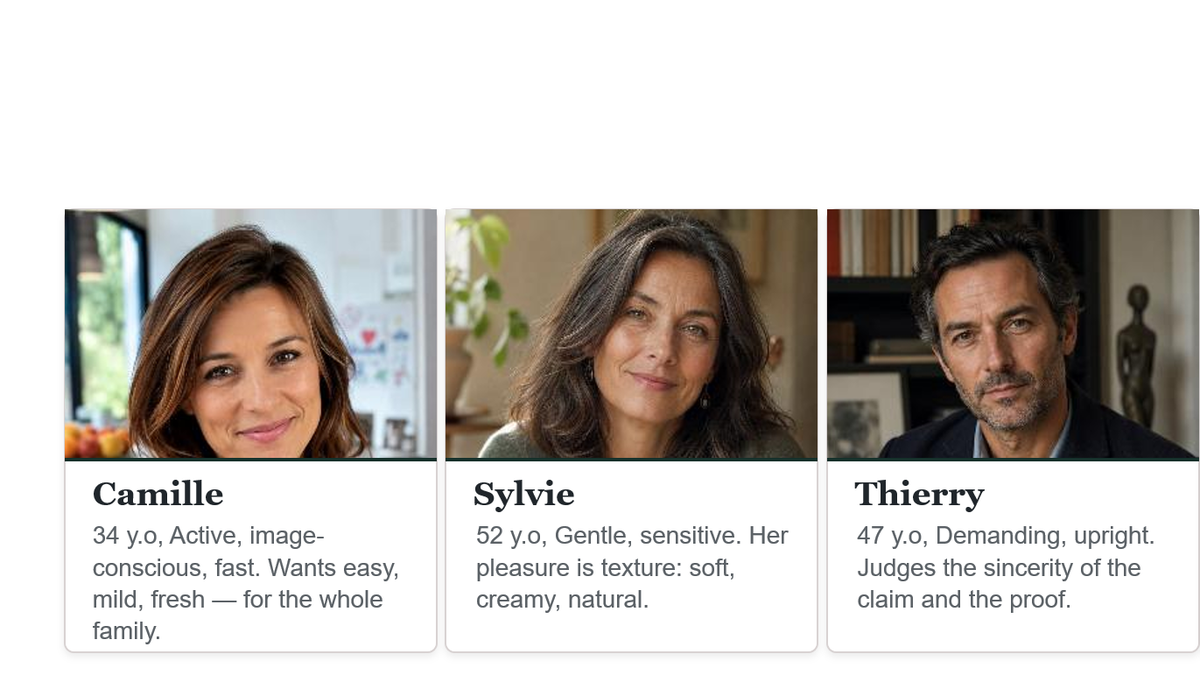
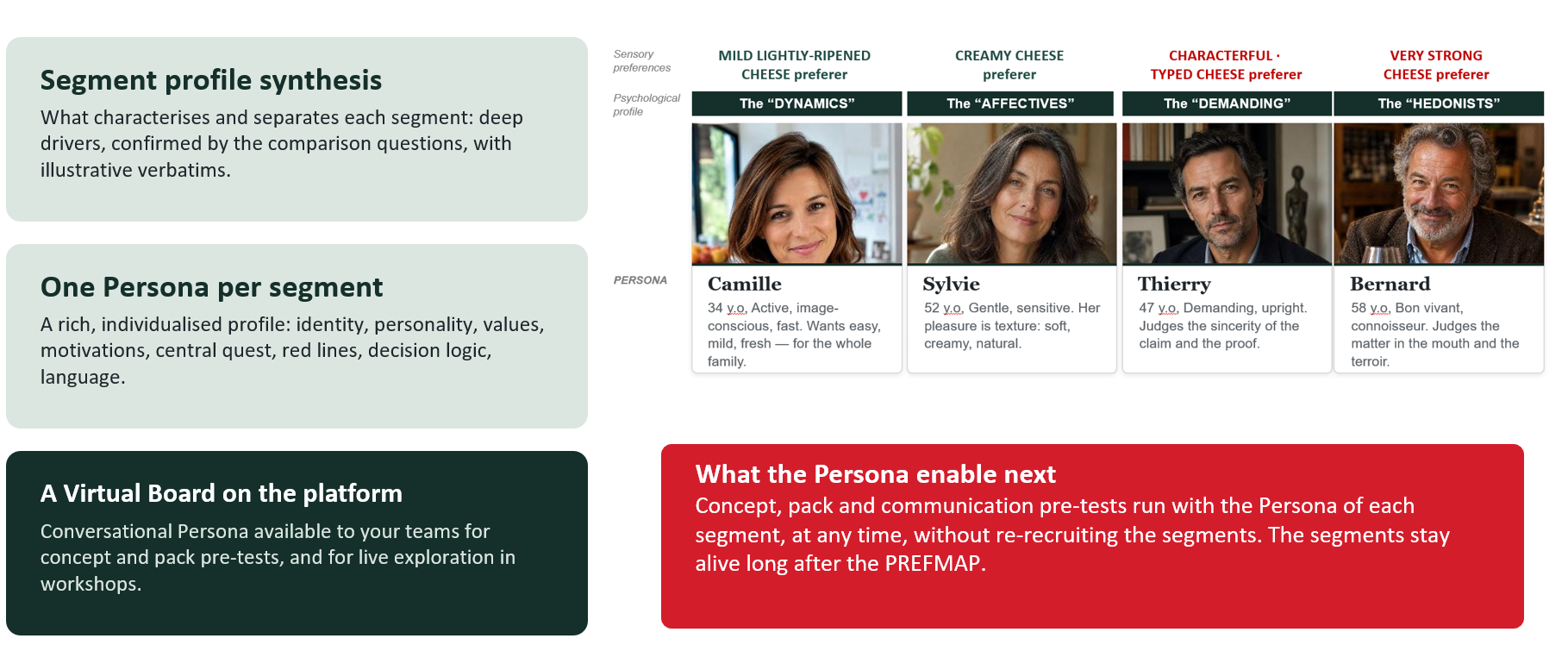
The analysis combines the psychometric profiles with the deep drivers uncovered in the interviews. It first produces a synthesis of what characterises and distinguishes each segment. Then one Persona per segment: a rich, individualised profile with its own identity, personality, values, motivations, red lines, decision logic and language.
Talk to your Personas
The Personas are available on a chat platform, as a Virtual Board made available to your teams. Realistic and interactive, they allow you to:
- pre-test concepts, packs and communications with each segment's Persona;
- explore live, in workshops with marketing and R&D teams;
- come back to them at any time, without recruiting the segments again.
Your segments stay alive long after the Prefmap, well beyond a simple report full of figures!
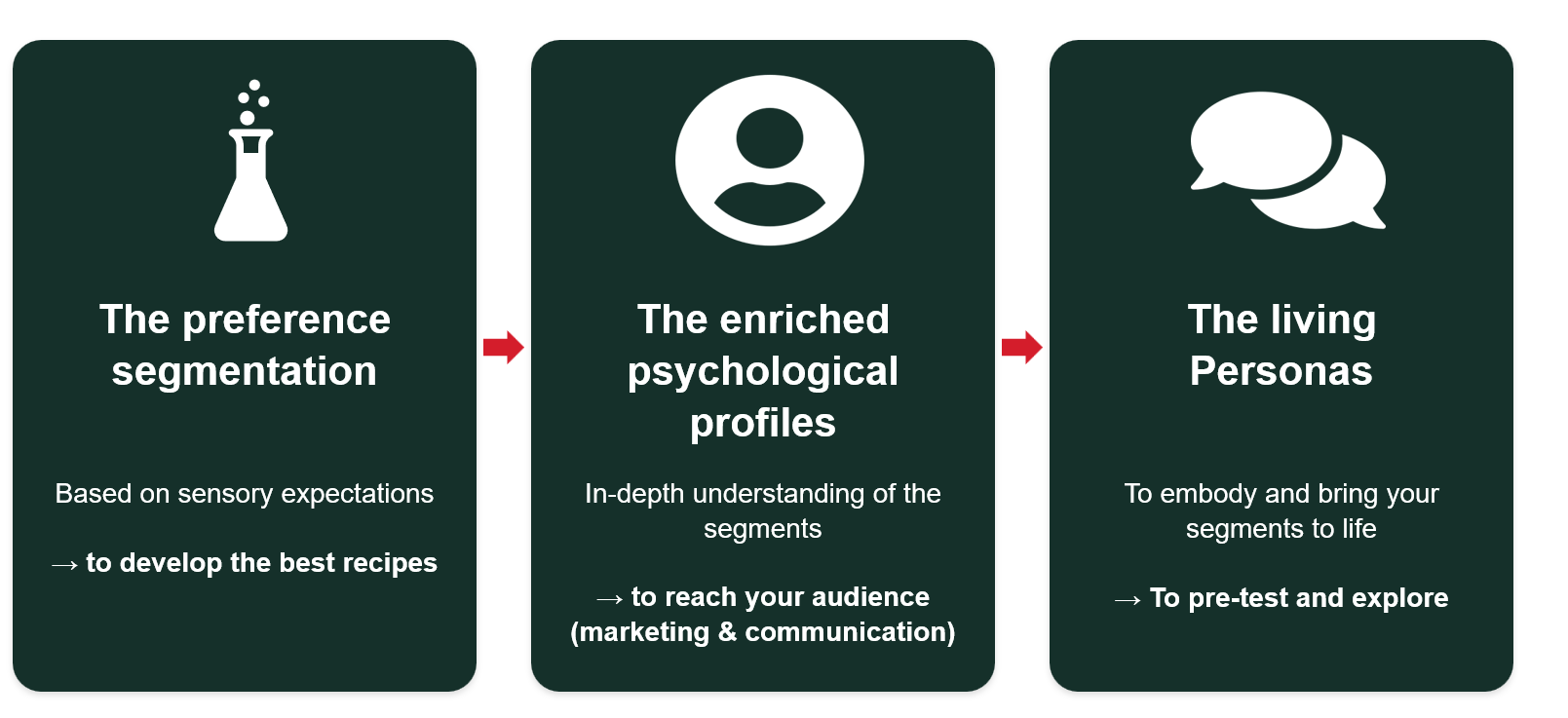
Your Prefmap thus delivers three levels of value
Planning a Prefmap or looking to get more out of an existing study? Tell us about your category and your challenges: we will propose the right approach, from the psychometric questionnaire to the Personas.
Contacts: Bénédicte Lunel – b.lunel@reperes.net · François Abiven – f.abiven@reperes.net
See also our other recommendations for optimised Prefmap studies:
RECO#1: CAPITALIZE ON CONSUMER SPONTANEOUS FEELINGS TO GO BEYOND SIMPLE LIKING
RECO#2 : OPERATIONAL AND ACTIONABLE SEGMENTATION OF PREFERENCE
RECO#3 : BETTER UNDERSTAND AND TARGET YOUR PREFERENCE SEGMENTS
RECO#4: INTEGRATING LIKING INTO THE CONSTRUCTION OF THE SENSORY MAP