Observe, feel, understand: going beyond declarative data in product tests with AI
Liking scales, attribute profiles, often thin open-ended questions: product tests still rely heavily on what consumers declare. Yet what they do, what they say in the moment and what they declare afterwards do not always match. By combining video observation, emotional measurement and projective verbalisation on the same respondents, it becomes possible to go well beyond declarative data, without significantly extending timelines or budgets, thanks to AI.
Why declarative data is no longer enough
The hedonic reaction to a product is largely automatic: it comes before verbalisation. When questioned afterwards, consumers rationalise, simplify, or give the answer they think they should give. Relying solely on declarative data therefore risks missing half the story.
Neurophysiological measures open up new perspectives, but they remain costly, difficult to deploy at scale and offer little diagnostic insight. As for observing real-life usage, it comes up against a practical obstacle: analysing hours of video by hand is not feasible on a quantitative sample.
Our answer: a multi-source, modular protocol that combines three more implicit levels of measurement on the same individuals. Observing behaviours, feeling emotional activation, understanding through in-depth projective verbalisation. AI makes the whole approach workable by processing video and text corpora across the entire sample.
Observe: what comes before words
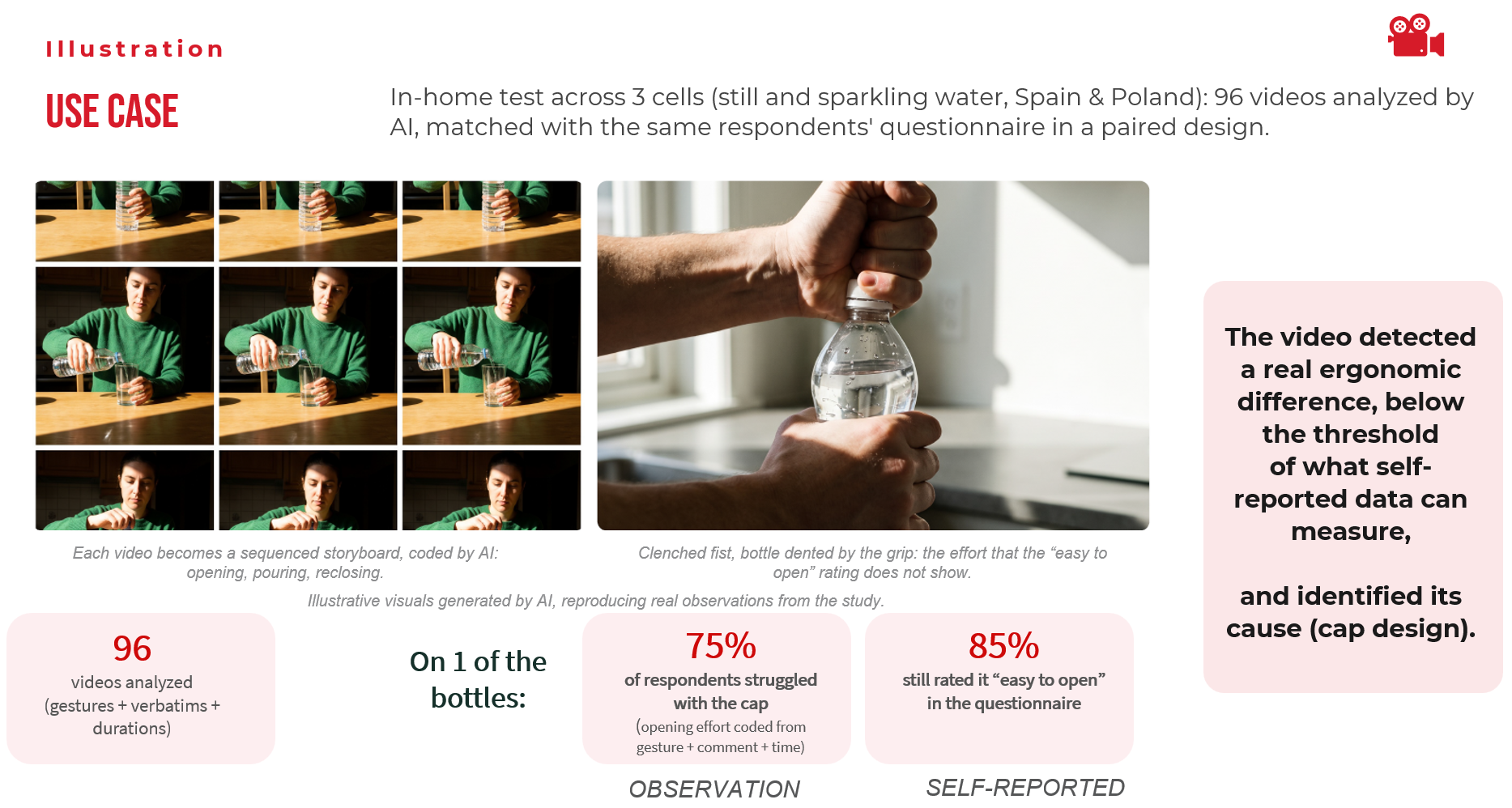
In an in-home test, consumers use the product at home, over several days, at their own pace, in their kitchen, bathroom or living room. Respondents are now used to filming themselves: they easily document their usage and the results they get in photos or videos.
What changes is the processing. AI analyses every video, for 100% of respondents:
- it sees: gestures, hesitations, effort, facial expressions, non-verbal reactions;
- it hears: spontaneous comments during use, transcribed, translated and coded, often more sincere than the rating given afterwards;
- it measures: handling or consumption times, objective indicators that are comparable across products.
Each video is then linked to the same individual's questionnaire answers. What is observed, expressed and declared can be read on the same people, making it possible to identify hidden pain points and understand their causes. The whole process remains under systematic human supervision, with consent, anonymisation and deletion of files at the end of the study. Results are delivered as an illustrated report (image boards, verbatims, per-video tables, paired statistical tests), alongside the quantitative report.
Feel: measuring emotional engagement
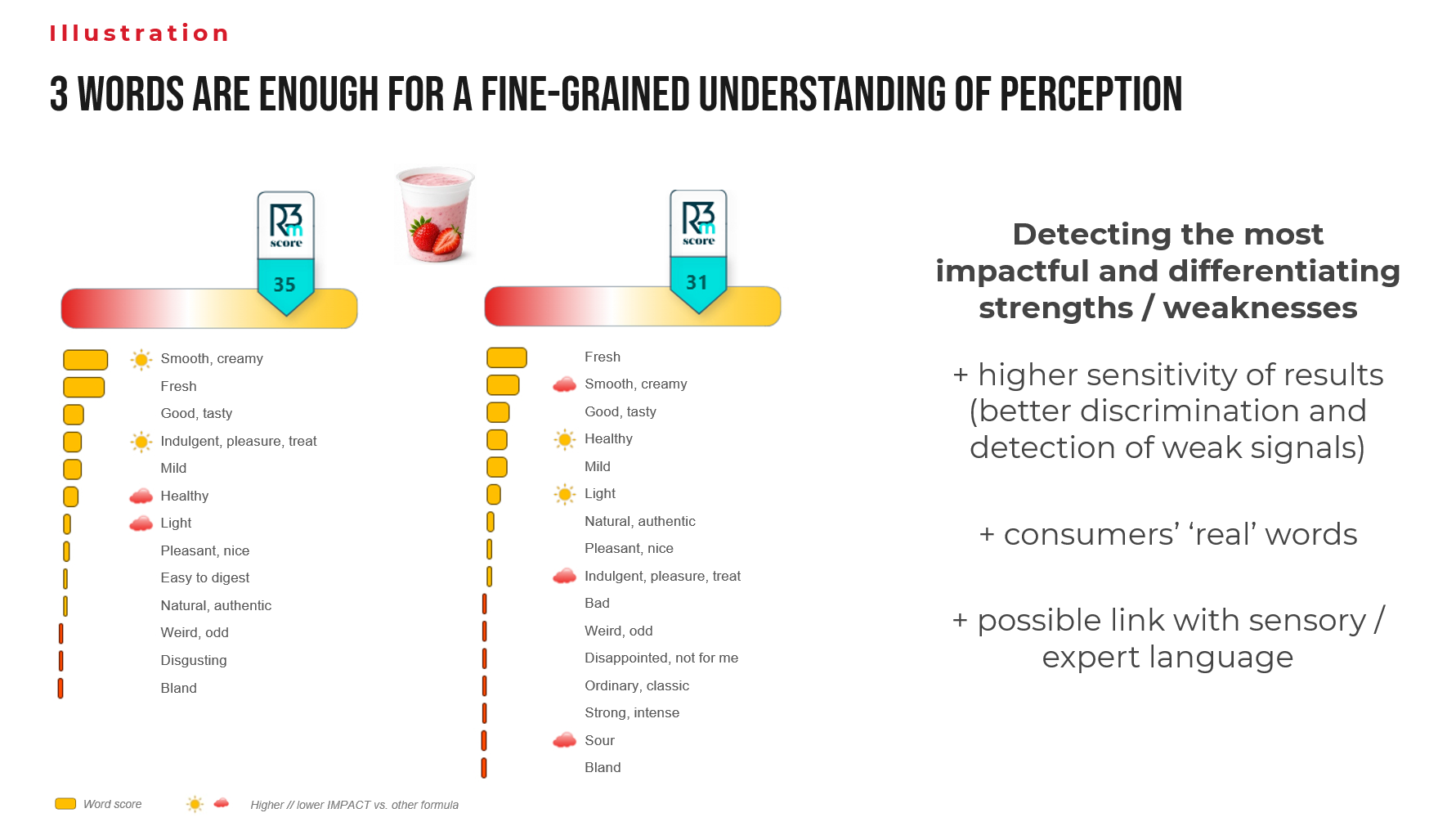
Second level: capturing the automatic responses and unconscious associations triggered by the product. Our R3mScore measure relies on a single question, asked right after use: “What are the first three words that spontaneously come to mind?”.
With no sentence, no justification and no suggested list, the answer stays as close as possible to System 1, the fast, intuitive thinking described by Kahneman. A weighting algorithm, based on the dimensional theory of emotions, scores each word according to its valence and intensity to produce an emotional activation index. The words themselves, in consumers' own vocabulary, shed light on the functional and emotional drivers of the experience.
Combined with overall liking in the Alpha score, the R3mScore increases discriminating power by 20% on average compared with liking alone (129,000 evaluations, 17 studies). A quick measure, free from leading bias, that makes the questionnaire shorter while making it richer.
Understand: qualitative depth at quantitative scale
Third level: bringing out what closed scales overlook. The approach is built on three building blocks.
- An open-ended, projective questionnaire, administered after use to the whole sample. It explores automatic associations, the sensory and functional experience, projection and personification, and the product's identity: what makes it unique, what it must keep, and what could evolve.
- AI that reads and probes. At several points in the journey, it analyses the respondent's answer and generates a personalised follow-up question to dig deeper. An AI summary, validated by the respondent, closes the interview.
- Fine-grained semantic analysis, AI-assisted and led by our experts, which structures thousands of verbatims and makes them quantifiable and cross-analysable by sub-target.
The added value of follow-up probing is tangible, both quantitatively (number of verbatims) and qualitatively, as it changes the nature of what people say: a generic adjective like “effective” becomes a precise benefit, “fewer deep wrinkles”; an impression of a “velvety feel” turns into an actionable sensory description; and a projective question can reveal strong emotional attachment. You get the depth of a qualitative interview, without qualitative fieldwork or recontact: each verbatim is explored at the moment it is given.
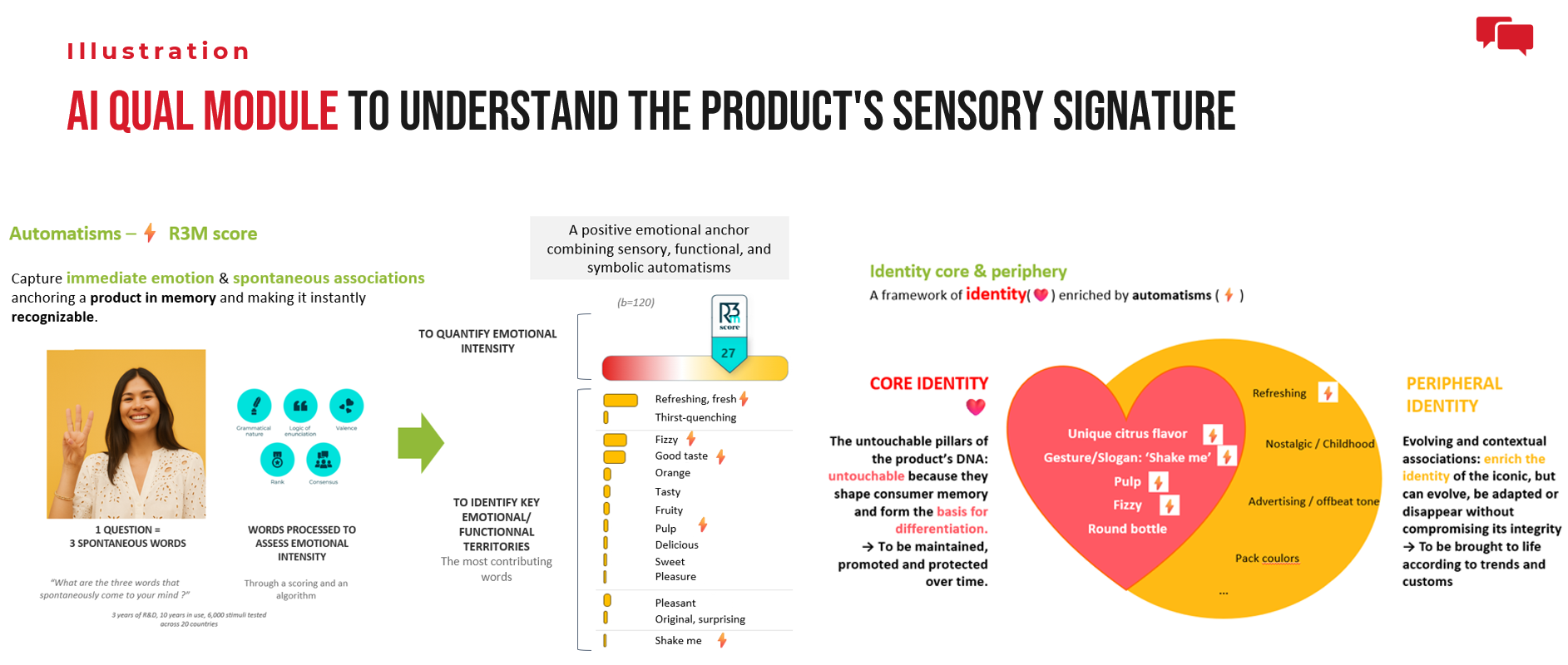
To decode the product's sensory signature, the analysis structures the corpus into a three-layer perceptual map:
- automatic associations, spontaneously anchored in memory and instantly recognisable;
- non-negotiable identity attributes, the core of the product, to be protected;
- peripheral dimensions, which can evolve without risk.
Product testing thus changes in nature:
- Video becomes a source of measurement, no longer just an illustration. It captures what the questionnaire cannot see.
- Qual scales up to quant. Every respondent's discourse is processed in full: the trade-off between richness and representativeness disappears.
- Value shifts towards interpretation. AI handles the volume and adjusts the questions, but it does not decide what matters. Our teams check, connect the signals and turn them into recommendations for marketing and R&D.
AI does not replace expertise: it pushes back its limits. Observing an entire sample, digging into every verbatim, analysing hundreds of videos in a few hours: what was once out of reach is becoming our standard.
👉 Want to know more? Contact us!


