/reboot/media/cb1ca522-65d6-11ef-8660-0242ac120010/fdff0ab0-cb93-11f0-a169-e6fe014dd4c8/1-1-a-heart-is-shown-on-a-computer-screen-kgltfcgfc28.jpg)
How to optimise your Preference Mapping and segmentation? RECO#4
Augmented Preference Mapping: integrating overall liking into the construction of the sensory map via MFA for better preference modelling
Preference Mapping (or PrefMap) is a key tool for connecting a product's sensory profile to the pleasure it generates for consumers.
Whether used to optimise recipes, steer innovation, or guide repositioning strategies, it allows teams to precisely identify the sensory levers that drive preference.
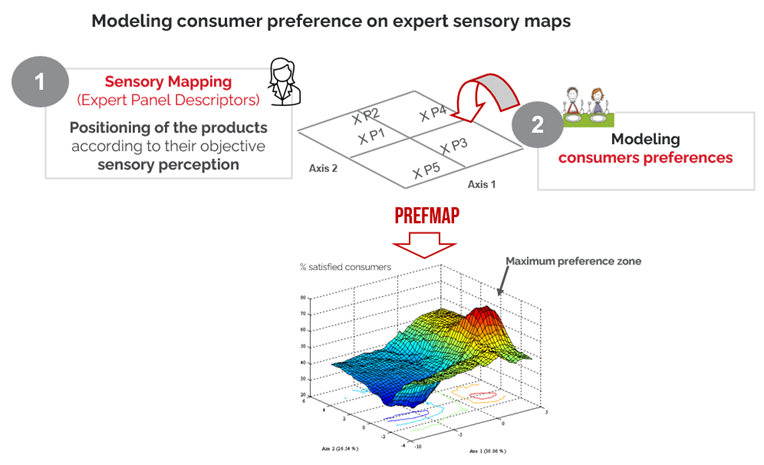
However, achieving a coherent alignment between expert perception (from trained sensory panels capable of describing products with great precision) and consumer reality (where preference is subjective, emotional, and often heterogeneous) remains a major challenge.
This is why, at Repères, we recommend integrating overall liking directly into the construction of the sensory map using Multiple Factor Analysis (MFA). This approach provides a more robust, more faithful representation, better aligned with what truly drives consumer preference.
🎯Why a PCA on sensory data is not always enough to understand consumer preference
PCA (Principal Component Analysis) is the traditional tool used to represent the sensory space based on descriptors generated by an expert panel. It provides a simple, effective visualisation of product differences as perceived by experts.
But when the goal is to model consumer preference, this expert-driven positioning often shows its limits.
1. PCA reflects expert perception… not consumer perception
Expert panels are trained to detect and quantify fine nuances-nuances that consumers may not notice, or to which they assign no importance.
As a result, some sensory axes that are highly structuring for experts do not explain consumer preference at all.
2. PCA gives equal weight to all descriptors
PCA does not account for the fact that some dimensions:
• are invisible to consumers
• trigger no emotional response
• do not contribute to preference
The sensory model may therefore be “distrubed” by attributes that have no real impact on liking.
3. PCA becomes difficult to exploit when preferences are heterogeneous
In markets where tastes are highly segmented (a very common case!), consumer preferences do not always align neatly with sensory positioning.
This makes preference modelling difficult and limits the reliability of the resulting analysis.
⭐ MFA: building the sensory space based on “what really matters”
Multiple Factor Analysis (MFA) integrates consumer overall liking directly into the construction of the sensory space.
This approach, notably theorised by Thierry Worch (2013)*, aligns the sensory map with the dimensions that genuinely determine preferences.
In practice, integrating liking into the model makes it possible to:
• capture the dimensions truly linked to preference, even when they are not found on the first sensory axes
• reduce the influence of “expert-only” attributes-those consumers do not perceive or use, which introduce noise into a classical PCA
• align the sensory structure with hedonic responses, essential when preferences are heterogeneous
• stabilise preference zones and drivers, providing a more robust identification of the “ideal product”
The sensory map is thus redesigned to improve consistency with preference segments and optimise modelling.
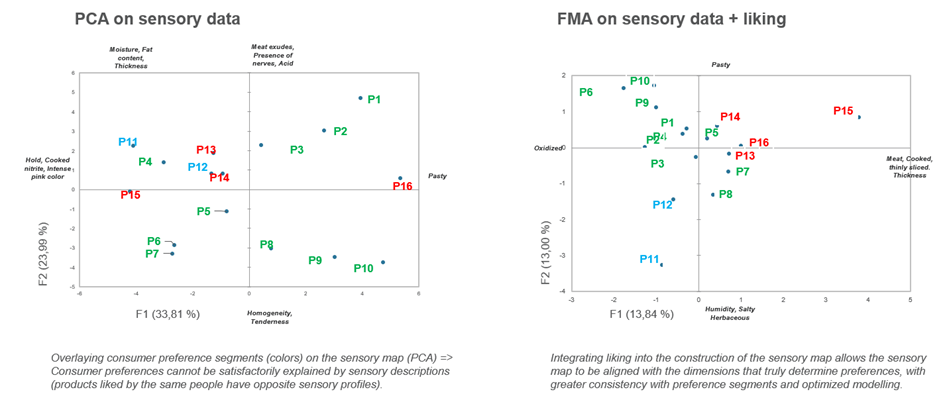
By integrating liking and sensory data into a common space, MFA delivers a more relevant, more explanatory, and more predictive PrefMap.
At Repères, we use it whenever data conditions allow, because it generates more accurate insights and more reliable decisions.
* See Thierry Worch's article “PrefMFA, a solution taking the best of both internal and external preference mapping techniques” here
Also, see our other recommendations for optimized prefmap studies:
RECO#1: CAPITALIZE ON CONSUMER SPONTANEOUS FEELINGS TO GO BEYOND SIMPLE LIKING
RECO#2 : OPERATIONAL AND ACTIONABLE SEGMENTATION OF PREFERENCE
RECO#3 : BETTER UNDERSTAND AND TARGET YOUR PREFERENCE SEGMENTS
PREFERENCE MAPPING WITHOUT SENSORY DATA IS POSSIBLE!
/reboot/media/cb1ca522-65d6-11ef-8660-0242ac120010/17da9786-873f-11f0-a8ff-1a3d8e5696a4/1-1-1756736537887.png)
/reboot/media/cb1ca522-65d6-11ef-8660-0242ac120010/9977c554-d1f7-11f0-98f1-028903021749/1-1-heart-shaped-pink-sparklers-photography-hbzrr6m6-pc.jpg)
/reboot/media/cb1ca522-65d6-11ef-8660-0242ac120010/56c7dfd8-3d00-11ef-bca9-0242ac120012/1-1-download.jpg)