/reboot/media/cb1ca522-65d6-11ef-8660-0242ac120010/9977c554-d1f7-11f0-98f1-028903021749/1-1-heart-shaped-pink-sparklers-photography-hbzrr6m6-pc.jpg)
Key Product Assets: Repères’ exclusive method for revealing a product’s identity-building assets
In a context where innovation accelerates and brands must reinvent themselves without losing their soul, understanding what truly defines a product's identity has become essential.
What makes it unique, instantly recognisable and emotionally irreplaceable…
and what, conversely, can evolve without risk?
To address this challenge, Repères has developed Key Product Assets: an exclusive approach designed to easily identify the identity-building pillars of a product.
This method guides renovation, evolution or portfolio extension decisions while preserving the product's emotional and symbolic coherence.
From brand theory to product identity: understanding a product's core assets
Our approach draws on two foundational bodies of work:
1. Géraldine Michel – Core Identity vs. Peripheral Identity
Michel distinguishes:
- the core identity-elements with strong symbolic and emotional meaning that form the brand's DNA;
- the peripheral identity-more flexible elements that can adapt to trends and evolve over time.
👉 Applied to products, this distinction makes it possible to determine what must be preserved at all costs to maintain authenticity, and what can evolve to remain contemporary and relevant.
2. Byron Sharp – Distinctive Brand Assets
Sharp highlights the distinctive cues-shapes, colours, sounds, taglines, textures-that anchor a brand in memory.
👉 Applied to products, this framework uncovers the memory cues that drive immediate recognition at first glance or first use.
By combining these two perspectives, our Key Product Assets approach decodes product identity by analysing how its concrete attributes-visual, sensory and functional-activate emotional and cognitive automatisms.
A hybrid and agile consumer methodology
To identify Key Product Assets simply and efficiently, Repères uses an agile methodology combining qualitative depth, quantitative robustness, and AI-augmented semantic analysis.
Our standard framework is based on 120 online interviews, following a highly open, exploratory and projective questionnaire structured around four key areas:
- Product / brand automatisms
- Experienced sensory and functional cues
- Projection and personification of the product
- Perceived evolution paths and non-negotiables
A fine-grained semantic analysis (AI + human expertise)
This dual analysis allows us to distinguish:
• Automatisms (⚡)
Sensory, functional or symbolic elements embedded in memory and granting instant recognisability.
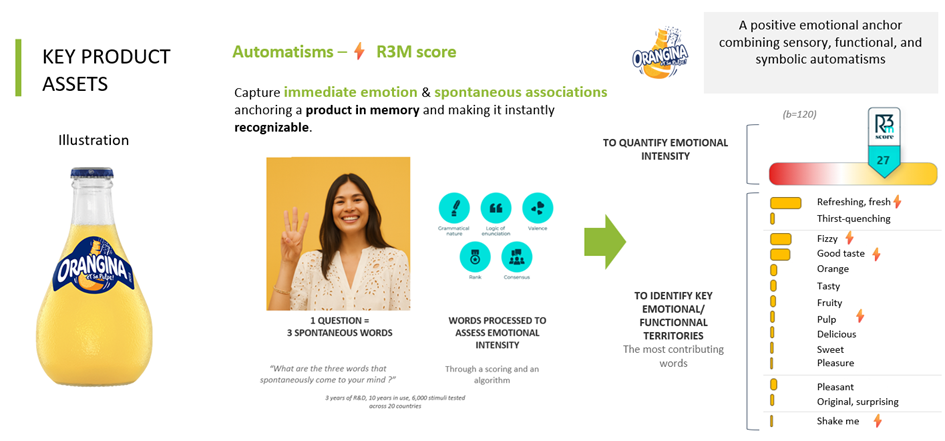
These are measured using our proprietary R3M Score, which captures immediate emotional activation and spontaneous associations.
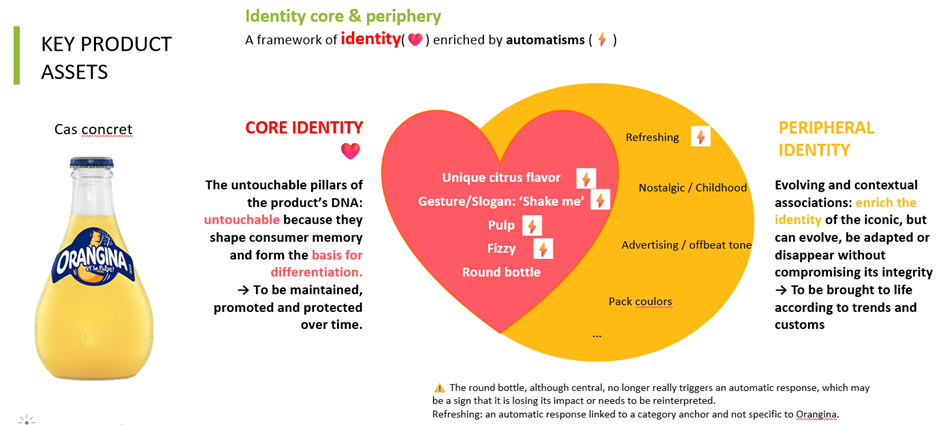
• Core Identity (❤️)
Highly symbolic, meaningful and emotionally charged dimensions that embody the product's uniqueness.
These are the identity-building pillars that must be preserved.
• Peripheral Identity (✨)
Elements that enrich expression or style but can be reinterpreted without compromising the product's DNA.
This analysis gives marketing and R&D teams a clear, operational framework for understanding:
- what to protect, strengthen and amplify,
- and what can be modernised or reinvented without losing the product's essence.
Illustration: How Orangina Reveals Its Identity-Building Assets
For Orangina, the analysis of spontaneous associations (automatism ⚡ cues) shows a strong emotional imprint combining:
- sensory automatisms: fizziness, citrus taste, pulp
- functional associations: refreshing
- symbolic cues linked to its famous gesture/tagline: “Shake me”
These are the product's emotional entry points-what is immediately triggered when consumers think of Orangina.
We then explore Orangina more deeply through:
- lived sensory and functional experience,
- projection and personification,
- the elements consumers consider absolutely essential.
Combined with emotional intensity analysis, this allows us to identify the core identity pillars-the symbolic, affective and differentiating attributes that must be preserved.
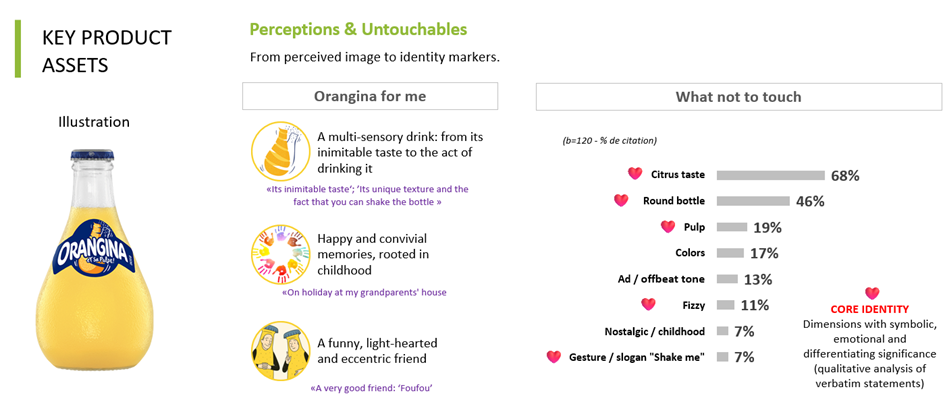
For Orangina, these include its unique citrus taste, its pulp, its fizz, its iconic “Shake me” gesture/slogan.
In contrast, elements such as its quirky advertising tone or nostalgic associations belong to the peripheral identity, which can evolve more freely.
However, our analysis also highlights a dynamic reality:
the once-iconic round bottle, although still symbolically strong, no longer activates emotional automatisms as powerfully as before.
It remains meaningful-but may require contemporary reinterpretation to regain its distinctive strength.
A strategic tool for innovating without losing your essence
Key Product Assets is a powerful and agile method for revealing a product's DNA and guiding its evolution with precision and security.
An essential approach for evolving a product…
without ever losing what makes consumers recognise it and love it.
/reboot/media/cb1ca522-65d6-11ef-8660-0242ac120010/17da9786-873f-11f0-a8ff-1a3d8e5696a4/1-1-1756736537887.png)
/reboot/media/cb1ca522-65d6-11ef-8660-0242ac120010/fdff0ab0-cb93-11f0-a169-e6fe014dd4c8/1-1-a-heart-is-shown-on-a-computer-screen-kgltfcgfc28.jpg)
/reboot/media/cb1ca522-65d6-11ef-8660-0242ac120010/56c7dfd8-3d00-11ef-bca9-0242ac120012/1-1-download.jpg)